







AI-Native Startups
The rise of AI-native startups are reshaping entrepreneurship. Learn how founders use AI as a first employee, how industries are shifting and what opportunities exist for new businesses in 2026.

The New Blueprint for Building Companies
Entrepreneurship in 2026 will feel like someone quietly updated the laws of physics. Tasks that once took teams now take a founder with an LLM as a sidekick. Investors are backing companies that don’t merely use AI but are built around it—AI in the workflows, AI in the customer interactions, AI deciding what to test next, and sometimes even AI making product improvements overnight.
The phrase AI-native startup describes this emerging species of business: ventures architected with AI as an operational core rather than an accessory.
This shift is altering product cycles, team structures, cost models, and the psychology of entrepreneurship. The result is a strange, electric new frontier.
Why AI-Native Startups Are Exploding
The acceleration isn’t accidental. Three forces are converging:
• Falling cost of intelligence: LLMs act like infinitely patient analysts, testers, designers, and customer agents.
• Founders operating at “team velocity”: A single entrepreneur can ship like a 5–7 person team from 2018.
• Market demand for speed: Customers expect products to evolve weekly, not quarterly. Only AI-augmented structures can keep up.
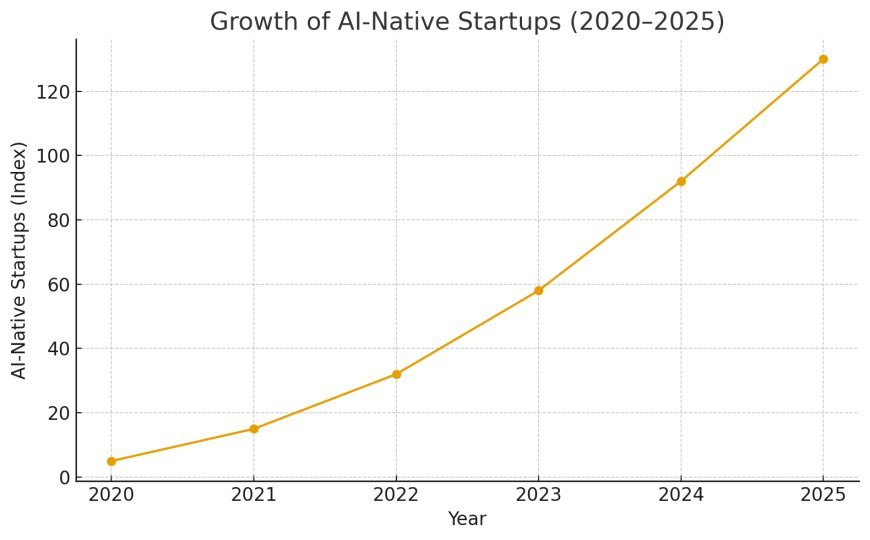
The chart below visualizes the hypothetical global growth trend of AI-native startups:
How AI-Native Startups Differ from Traditional Tech Startups
A traditional startup treats AI as a tool.
An AI-native startup treats AI as infrastructure.
Here’s what that means in practice:
1. AI Handles First Drafts of Everything
• Business plans
• Market research
• Customer support scripts
• UI layouts
• Partner outreach emails
• Growth campaigns
Founders edit instead of originate.
2. Autonomous or Semi-Autonomous Workflows
AI agents run internal loops:
• Monitor KPIs in real-time
• Flag anomalies
• Propose product changes
• Launch controlled A/B tests
• Generate user-specific marketing
This creates a company that “thinks out loud” in a continuous analytical hum.
3. Hyper-Personalized Customer Experiences
The same product can behave differently for two customers because AI dynamically adapts:
• Recommends tailored features
• Customizes onboarding
• Creates support responses based on user history
• Predicts churn and intervenes
This kind of personalization used to require large datasets and multiple departments. Now even tiny startups can pull it off.
4. Product Velocity Shifts From Linear to Exponential
In conventional startups, shipping new features slows as complexity grows.
AI-native startups defy this curve because AI handles much of the scaffolding and incremental code.
The Industries Being Reshaped First
Some sectors are already mutating under the AI-native wave.
• SaaS and Productivity
AI agents automate onboarding, generate workflows, and adapt dashboards to each user.
• E-commerce
AI-native stores analyze user behavior, generate personalized product bundles, and write dynamic product descriptions.
• Education
AI tutors create individualized learning paths. Micro-academies build curricula on the fly.
• Healthcare Operations
Scheduling, triage, patient messaging, and follow-ups can be entirely AI-driven in private clinics and telemedicine setups.
• Media and Content
AI-native publishers produce articles, videos, and visuals based on audience signals detected minute-by-minute.
These industries reward speed, personalization, and automation—the natural territory for AI-native founders.
Opportunities for New Entrepreneurs
This shift opens a landscape filled with opportunity:
Build AI Variants of Old Industries
• AI-native accounting
• AI-native real estate management
• AI-native recruiting
• AI-native compliance monitoring
Take a traditional business. Rebuild it around AI. Watch the cost structure implode in your favor.
Verticalized AI Agents
These are specialized “micro-brains” trained to understand:
• legal documents
• medical imaging
• fleet operations
• agricultural data
• export logistics
One founder + one trained agent can penetrate industries that once required corporate-scale resources.
AI-Native Marketplaces
Platforms that self-moderate, self-verify, and self-organize buyer–seller interactions.
The Challenges (and Why They’re Fascinating)
AI-native startups aren’t utopian. They come with real complexity.
• Over-reliance on models: If the underlying AI updates, your workflow might break overnight.
• Interpretability issues: Why did the AI do what it did? Sometimes nobody knows.
• Ethical shadows: Customer data, personalization limits, and potential hallucinations.
• Founder skill shift: Understanding AI becomes more crucial than understanding traditional management.
These challenges aren’t bugs—they’re the contours of a new entrepreneurial landscape.
The Future
Eventually, “AI-native” won’t be a special category. It will be the default blueprint for building anything.
When intelligence becomes as cheap and abundant as electricity, founders stop thinking about “manpower” as a limiting factor.
The companies of the next decade will be stranger, sleeker, faster, and more adaptive than anything from the first wave of the internet. New power laws will appear. Tiny teams will challenge giants. Product cycles will feel alive.
You can build follow-up pieces on micro-SaaS empires, AI-led product development, or the new economics of one-founder companies.
Entrepreneurship will get wilder—and more accessible.
What's Your Reaction?
 Like
0
Like
0
 Dislike
0
Dislike
0
 Love
0
Love
0
 Funny
0
Funny
0
 Angry
0
Angry
0
 Sad
0
Sad
0
 Wow
0
Wow
0